

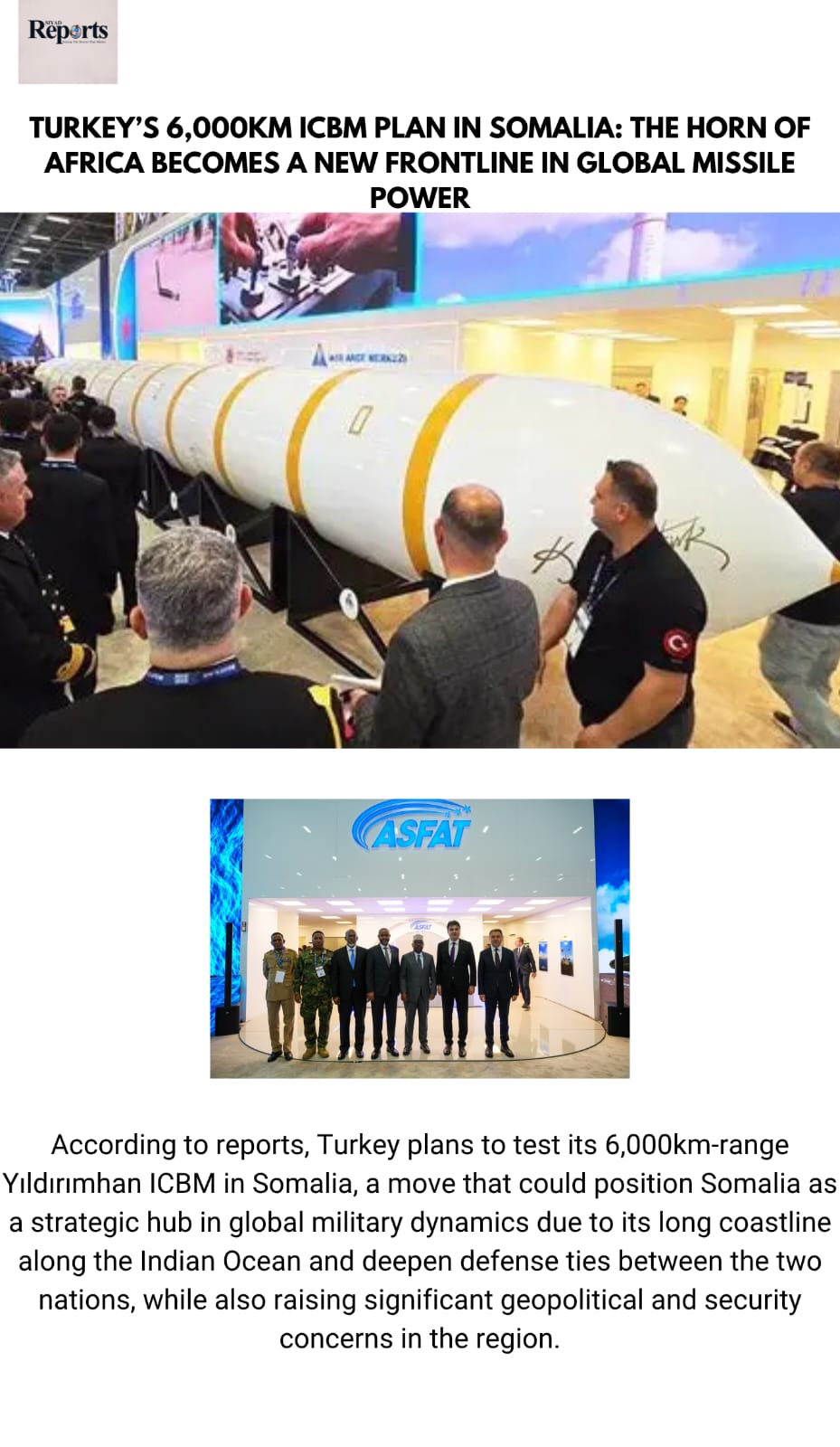
A report attributed to Bloomberg has ignited one of the most consequential geopolitical discussions of the year: that Turkey is planning to test its first intercontinental ballistic missile, the “Yıldırımhan,” in Somalia potentially later this year. The missile, described as having a range of roughly 6,000 kilometers, would place Ankara within a narrow circle of states capable of projecting long-range strike power across continents.
The detail that sharpens the story, however, is not only the weapon itself, but the proposed geography of its testing. Somalia long framed in global discourse through the lens of fragility and recovery is suddenly positioned at the intersection of advanced missile development, maritime strategy, and great-power competition.
What is being reported is not an official declaration, but a plan cited by sources familiar with the matter, reflecting the sensitivity surrounding missile programs and host-nation arrangements. Yet even as a plan, it carries weight. It signals intent. It reveals trajectory. And it forces a recalibration of how Somalia is viewed in the emerging map of security alignments.
The suggestion that a long-range ballistic missile could be tested from Somali territory, over the vast openness of the Indian Ocean, points to a convergence of military necessity and geographic opportunity one that binds Ankara’s ambitions with Mogadishu’s evolving strategic relevance.
At the center of the story is the Yıldırımhan system itself. While full technical specifications remain limited in the public domain, the classification of the missile as an intercontinental ballistic missile combined with a stated range in the 6,000-kilometer bracket implies a system designed for high-altitude, long-distance trajectories, capable of reaching targets far beyond immediate regional theatres.
In the hierarchy of missile technology, this is a leap beyond tactical or theater systems. It is a statement of reach. For Turkey, a country that has steadily invested in indigenous defense capabilities over the past decade, the unveiling of such a system marks an attempt to transition from a regional military power into one with extended strategic depth.
The context in which this development occurs is crucial. Turkey’s defense industry has undergone a significant transformation, moving from reliance on foreign procurement to domestic production across drones, naval vessels, armored systems, and missile technologies.
The emergence of an ICBM-class system aligns with Ankara’s broader doctrine of strategic autonomy reducing dependence on allies and creating leverage in a multipolar security environment. In that sense, Yıldırımhan is not merely a weapon; it is a symbol of industrial maturity and geopolitical intent.
Yet missiles do not exist in abstraction. They require testing, validation, and demonstration. And it is here that Somalia enters the narrative with unusual prominence. The idea of testing a long-range ballistic system demands space specifically, safe corridors over open water where trajectories can be observed without endangering populated areas or violating neighboring airspace.
Somalia’s extensive coastline one of the longest in mainland Africa offers precisely that: a gateway into uninterrupted maritime expanse. From a purely operational perspective, the geography is compelling.
Beyond coastline, Somalia’s position near the equator introduces additional, though often misunderstood, considerations. While equatorial proximity is more directly advantageous for space launch vehicles where the Earth’s rotational speed can be leveraged for efficiency it also contributes to broader aerospace planning, including range safety, tracking geometry, and potential dual-use infrastructure.
If Ankara’s long-term vision includes not only missile testing but also space-related capabilities, then Somalia’s latitude becomes part of a larger strategic calculation.
The presence of Somalia’s Defence Minister, Ahmed Moalim Fiqi, at the unveiling of the missile system underscores the diplomatic and military intimacy between the two states. This is not a relationship emerging overnight. It has been built over years through training missions, base agreements, humanitarian engagement, and defense cooperation frameworks.
Turkey operates one of its largest overseas military training facilities in Mogadishu, and Turkish officers have played a role in shaping segments of Somalia’s security forces. The reported plan to test a high-end missile system within Somali territory if realized would represent an escalation of that partnership into a new domain: strategic weapons collaboration.
This raises immediate and complex questions about sovereignty, consent, and strategic calculus. For Somalia, the decision to host such a test if it moves beyond planning would not be a purely technical one. It would be a geopolitical act, carrying implications for its relationships with other partners, its position in regional organizations, and its exposure to international scrutiny.
The United Nations and other multilateral bodies monitor missile proliferation and testing activities closely, and any development involving long-range systems inevitably attracts attention from established powers.
There is also the matter of perception. Somalia’s image in international discourse has been shaped by decades of conflict, recovery, and state-building. Hosting a test associated with advanced missile technology could reframe that narrative projecting an image of strategic utility and partnership, but also inviting concerns about militarization and external influence.
For domestic audiences, it may be interpreted as a sign of deepening security ties with a powerful ally. For regional actors, it could be seen as a shift in the balance of influence along the Horn of Africa.
Midway through this unfolding analysis, it becomes clear that the significance of the reported plan extends far beyond a single test event. It touches on the architecture of power projection, the evolution of alliances, and the role of geography in shaping military possibilities.
FROM COASTLINE TO TRAJECTORY: WHY SOMALIA SITS AT THE CENTER OF TURKEY’S LONG-RANGE CALCULUS
To understand why Somalia appears in this equation, one must move beyond surface explanations and examine the layered intersection of geography, politics, and strategic ambition. The Horn of Africa occupies a critical position adjacent to some of the world’s most important maritime corridors, including approaches to the Red Sea and the Gulf of Aden.
Control, access, or even presence in this region offers visibility over shipping lanes that connect Europe, Asia, and the Middle East. For a country like Turkey, which has sought to expand its maritime and diplomatic footprint across multiple regions, anchoring itself in Somalia provides both symbolic and practical advantages.
The idea of using Somali territory for missile testing leverages this positioning. A launch directed eastward over the Indian Ocean minimizes overflight of populated or politically sensitive areas, allowing for cleaner test conditions. Tracking systems can be aligned along maritime paths, and recovery or observation zones can be managed with fewer complications than in densely networked continental spaces.
From a defense engineering perspective, these are not trivial considerations; they can determine the feasibility and frequency of testing cycles.
At the same time, Somalia’s willingness or potential willingness to engage in such cooperation reflects its own strategic needs. The Somali government has, over the past decade, sought to rebuild its security apparatus, diversify its partnerships, and assert greater control over its territory and institutions.
Partnerships with countries like Turkey have been instrumental in this process, providing training, equipment, and diplomatic backing. Expanding that partnership into higher-end domains could be seen as a natural, if controversial, extension of existing ties.
However, the asymmetry between the two partners cannot be ignored. Turkey brings technological capability, industrial infrastructure, and strategic experience. Somalia brings geography, access, and political consent.
The balance of benefits and risks will therefore be a subject of intense internal deliberation within Somali institutions. Questions of oversight, legal frameworks, environmental impact, and national interest will all come into play if the plan progresses.
From the perspective of global power dynamics, the reported plan adds another layer to an already complex picture. The group of countries commonly associated with long-range missile capabilities among them the United States, China, Russia, North Korea, India, and France has historically been defined not only by technology but by doctrine, deterrence posture, and, in many cases, nuclear capability.
Turkey’s entry into this space, even at the level of testing and development, signals an aspiration to be counted among states with extended reach. It does not immediately equate to parity with established nuclear powers, but it does shift perceptions of Turkey’s ceiling.
For other actors observing the Horn of Africa, the implications are equally significant. Regional states may reassess their own security postures. External powers with interests in the region whether economic, military, or political may increase engagement to maintain influence.
The Horn has long been a theater where global and regional interests intersect; the introduction of advanced missile testing into that environment could intensify that intersection.
The technical dimension of the Yıldırımhan system itself also warrants closer attention. A missile with a 6,000-kilometer range sits at the lower end of what is typically classified as intercontinental, but it is nonetheless capable of spanning vast distances.
Depending on payload, trajectory, and guidance systems, such a missile could be configured for a variety of roles, from conventional long-range strike to potential deterrence signaling. Reports that it may achieve hypersonic speeds during portions of its flight profile align with broader trends in missile development, where speed and maneuverability are used to complicate interception.
Testing such a system is not a single event but a series of iterations. Initial launches validate propulsion and structural integrity. Subsequent tests refine guidance, re-entry, and accuracy. Each stage generates data that feeds back into design and doctrine.
If Somalia becomes part of this testing cycle, it would, by extension, become part of the data ecosystem underpinning Turkey’s missile program. This is a profound level of integration, even if it remains limited to specific sites or timeframes.
It is also important to consider what has not been publicly detailed. The exact location within Somalia, the nature of any facilities to be used or constructed, the legal agreements governing such use, and the safeguards in place are all elements that remain opaque.
In the absence of official statements, analysis must rely on patterns, precedents, and the limited information available. This uncertainty is characteristic of defense reporting, where sensitivity and secrecy are inherent.
For Somalia, the path forward should the plan materialize will involve navigating a complex matrix of opportunity and risk. On one hand, deeper ties with a technologically advanced partner could accelerate aspects of military modernization, bring investment into infrastructure, and elevate the country’s strategic profile.
On the other, it could expose Somalia to external pressures, complicate its diplomatic balancing, and introduce new dimensions to its security environment.
For Turkey, the calculus appears to be one of expansion of capability, of reach, and of influence. Testing an ICBM-class system is as much about demonstration as it is about validation. Where that demonstration occurs matters.
Conducting it in Somalia would send a signal that Turkey’s strategic horizon extends into the Horn of Africa, and that its partnerships there are not limited to training or advisory roles but encompass high-end military collaboration.
In the end, the reported plan to test the Yıldırımhan missile in Somalia encapsulates a broader shift in how power is projected and perceived. It illustrates how geography can be leveraged in new ways, how partnerships can evolve into unexpected domains, and how regions once seen as peripheral can become central to global strategic calculations.
Whether the test proceeds as described, is delayed, modified, or reimagined, the conversation it has sparked will endure because it touches on the fundamental question of who holds reach, who provides space, and how those two realities intersect in a world where distance is increasingly no barrier at all.