

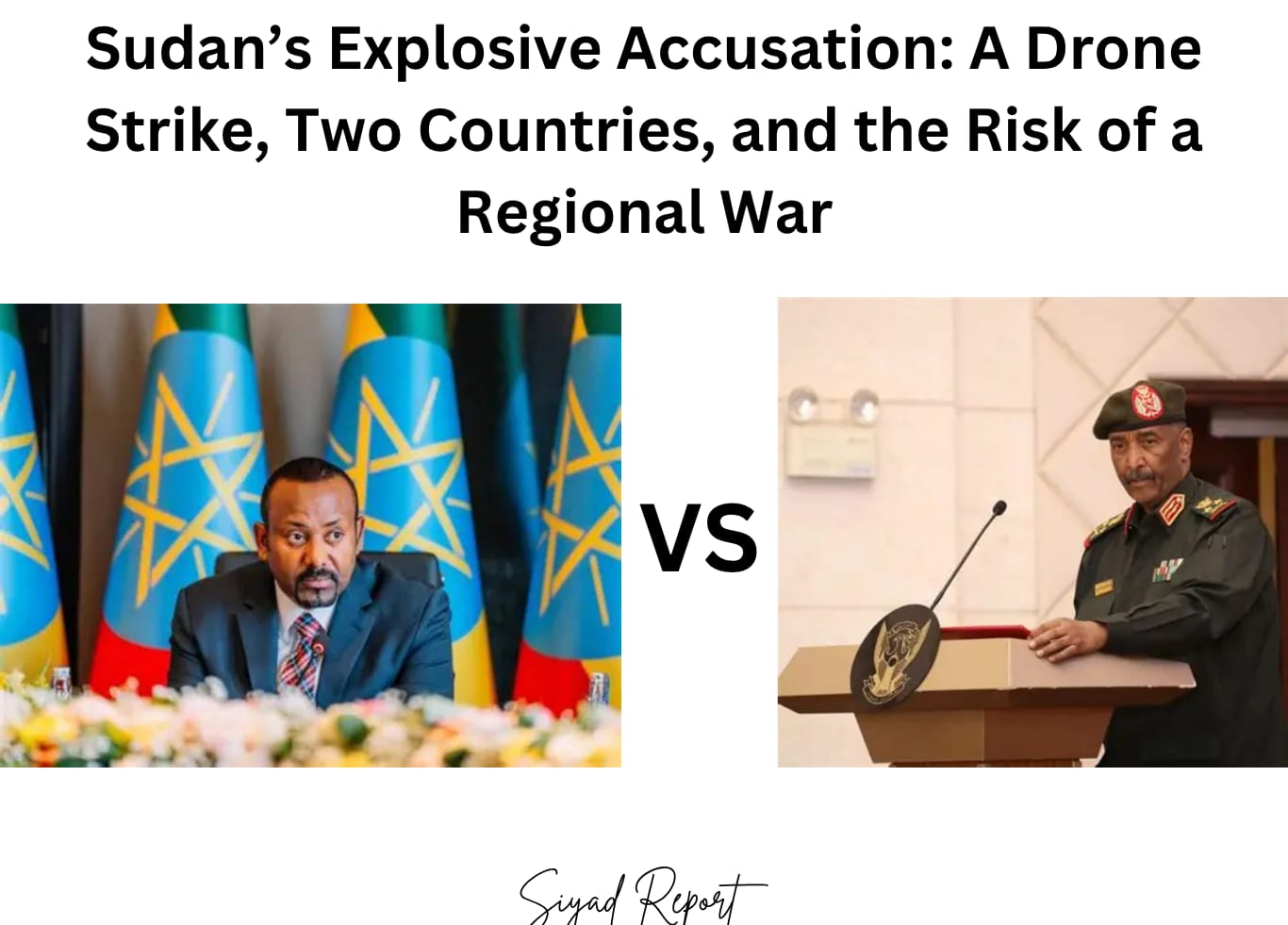
The war in Sudan has entered one of its most dangerous and defining moments yet. What began as a brutal internal struggle is now showing clear signs of evolving into a wider geopolitical confrontation.
In a bold and unprecedented move, Sudan’s military has accused Ethiopia and the United Arab Emirates of being directly linked to drone attacks targeting the capital, Khartoum including a strike that forced the shutdown of Khartoum International Airport.
According to Sudanese officials, the drones were allegedly launched from Ethiopian territory, specifically from Bahir Dar, while the UAE is accused of supplying the technology used in the attack. Sudan’s military spokesperson described the act as a “direct aggression,” signaling that the country views this not merely as an extension of its internal war, but as an external assault on its sovereignty.
The immediate diplomatic response recalling Sudan’s ambassador from Ethiopia underscores the seriousness of the accusation.
Both Ethiopia and the UAE have rejected the claims. Ethiopia dismissed them as baseless and countered by accusing Sudan of fueling instability and maintaining links with the Tigray People’s Liberation Front. A senior TPLF figure, however, denied any connection to Sudan and instead accused Addis Ababa of deflecting responsibility.
These conflicting narratives do more than create confusion they reveal a region where mistrust is deep, alliances are fragile, and truth itself is contested.
Yet, beyond the immediate exchange of accusations lies a deeper and more consequential reality. Sudan’s war is no longer contained within its borders. It is being pulled into a complex web of regional rivalries, strategic calculations, and long-standing geopolitical tensions that stretch across the Horn of Africa and into the Gulf.
Sudan has been engulfed in conflict since 2023, as the national army battles the Rapid Support Forces (RSF) in a war that has devastated cities, displaced millions, and crippled the state. Over time, the nature of the conflict has shifted.
What was once a conventional struggle has increasingly adopted asymmetric tactics, with drone warfare emerging as a key feature. These attacks have not only targeted military installations but also critical infrastructure, amplifying the humanitarian crisis and weakening already fragile institutions.
The allegation that foreign actors are now involved marks a turning point. Accusing the UAE suggests that Gulf powers long active in the Red Sea region may be shaping the conflict behind the scenes.
Accusing Ethiopia, however, carries even heavier implications. Unlike distant powers, Ethiopia is Sudan’s immediate neighbor, bound by geography, history, and unresolved disputes.
Relations between Sudan and Ethiopia have been strained for years. The contested Al-Fashaga border has been a recurring source of tension, with periodic clashes between farmers and military forces.
The dispute over the Grand Ethiopian Renaissance Dam has further complicated ties, as downstream countries fear the impact on water security. These unresolved issues have created a foundation of mistrust that makes any new accusation far more explosive.
Now, by alleging that attacks on Khartoum originated from Ethiopian territory, Sudan is effectively raising the stakes to a level that could justify retaliation. Whether or not the claim is substantiated, the perception alone is enough to deepen hostility. In geopolitics, perception often carries as much weight as reality.
At the same time, the involvement of the UAE if even partially true points to a broader strategic contest. The Red Sea has become one of the most important geopolitical corridors in the world, linking global trade routes between Europe, Asia, and Africa.
Countries with influence along this corridor hold significant economic and military advantages. Sudan, with its long coastline along the Red Sea, sits at the heart of this strategic space.
For Ethiopia,this geography is equally critical but from the opposite perspective. As a landlocked country since the independence of Eritrea, Ethiopia has long sought reliable access to the sea. Its economic growth, trade ambitions, and regional influence all depend on securing maritime access.
Sudan’s ports have historically been one of the key outlets for Ethiopian trade. Any instability in Sudan or any deterioration in relations directly affects Ethiopia’s strategic calculations.
This is what makes the current crisis so significant. It is not simply about a drone attack. It is about control, access, and influence over one of the most strategically important regions in the world. Sudan’s Red Sea coastline is not just a geographic feature it is a prize in a broader contest involving regional and global powers.
Ethiopia’s need for sea access and the UAE’s investments in port infrastructure across the region intersect directly with Sudan’s internal conflict, turning it into a battleground for competing interests.
In this context, Sudan’s accusation can be seen as both a warning and a signal. It is a warning that external involvement will not be tolerated, and a signal that the country is willing to escalate diplomatically and potentially militarily to defend its sovereignty. But it also reflects a deeper reality: Sudan is no longer in full control of its own conflict. External pressures, alliances, and rivalries are increasingly shaping the trajectory of the war.
From Drone Strikes to a Regional Power Struggle
What is unfolding now is the transformation of Sudan’s war into a regional contest with multiple layers of complexity. At one level, it remains a civil war between the army and the RSF. At another, it is becoming a proxy arena where external actors pursue their interests indirectly. And at an even deeper level, it is part of a broader struggle over the future of the Horn of Africa and the Red Sea.
The risk of Sudan becoming a proxy battlefield is no longer theoretical. History offers clear examples from Libya to Syria where internal conflicts became prolonged and more destructive due to external involvement.
In such scenarios, local actors are supported, armed, or influenced by foreign powers, each pursuing its own strategic goals. The result is a conflict that is harder to resolve and far more devastating for civilians.
Sudan shows many of these warning signs. Allegations of foreign support, strategic geography, and escalating diplomatic tensions all point in this direction. If the UAE is indeed backing one side, it would align with its broader strategy of securing influence along key maritime routes.
If Ethiopia is drawn into the conflict whether directly or through accusation it would represent a significant expansion of the war’s scope.
The implications for the Horn of Africa are profound. The region is already under immense strain. Somalia continues to face security challenges, Ethiopia is managing internal divisions following its own conflicts, and Sudan is in the midst of a full-scale war. Adding inter-state tensions to this mix creates the conditions for a wider regional crisis.
Conflicts in the Horn rarely remain contained. Borders are porous, alliances are fluid, and the impact of instability quickly spreads. Refugee flows increase, armed groups move across borders, and economic disruptions ripple through neighboring countries. What begins as a national crisis can rapidly evolve into a regional emergency.
Diplomatically, the situation is equally fragile. Sudan’s decision to recall its ambassador from Ethiopia is a clear sign that relations are deteriorating. Such moves reduce the space for dialogue and increase the risk of miscalculation. At the same time, Ethiopia’s strong denial and counter-accusations suggest that neither side is prepared to back down publicly.
This creates a cycle of escalation, where each statement hardens positions rather than opening paths to resolution.
The involvement of narratives around the TPLF further complicates matters. By linking Sudan to Ethiopian internal conflicts, Addis Ababa is broadening the scope of the dispute. Sudan, in turn, is internationalizing its own conflict by naming external actors. The result is a web of interconnected tensions that make the situation far more volatile.
Economically and strategically, the stakes continue to rise. The Red Sea corridor is not only vital for regional trade but also for global commerce. Any instability along this route has implications far beyond the immediate region.
Countries with interests in the Red Sea including Gulf states and other global powers are likely to watch developments closely, and potentially become more involved if their interests are threatened.
For Ethiopia, the issue of sea access remains central. Without direct access to the coast, it must rely on neighboring countries for trade routes. Sudan’s instability and the potential breakdown of relations could limit Ethiopia’s options, pushing it to seek alternatives or assert its interests more aggressively. This dynamic alone is enough to heighten tensions, even without the current accusations.
For Sudan, the challenge is even more immediate. It must navigate an internal war while managing external pressures. Accusing powerful regional actors carries risks, but it also reflects a sense of urgency and vulnerability. The country is signaling that its sovereignty is under threat not just from internal forces, but from external interference.
Ultimately, what is at stake is not just the outcome of Sudan’s war, but the future stability of an entire region. The Horn of Africa stands at a crossroads, where internal conflicts, regional rivalries, and global interests intersect. Sudan’s accusations have brought these tensions to the surface, exposing the fragile balance that has held the region together.
The coming days and weeks will be critical. If tensions continue to escalate, the risk of direct confrontation between states will grow. If diplomacy fails, the conflict could deepen and spread. And if external involvement increases, Sudan may fully transition from a civil war into a proxy battleground with far-reaching consequences.
What began as a drone strike over Khartoum now carries the weight of something much larger.
It is a moment that could redefine alliances, reshape regional dynamics, and determine whether the Horn of Africa moves toward greater instability or finds a path back from the brink.