

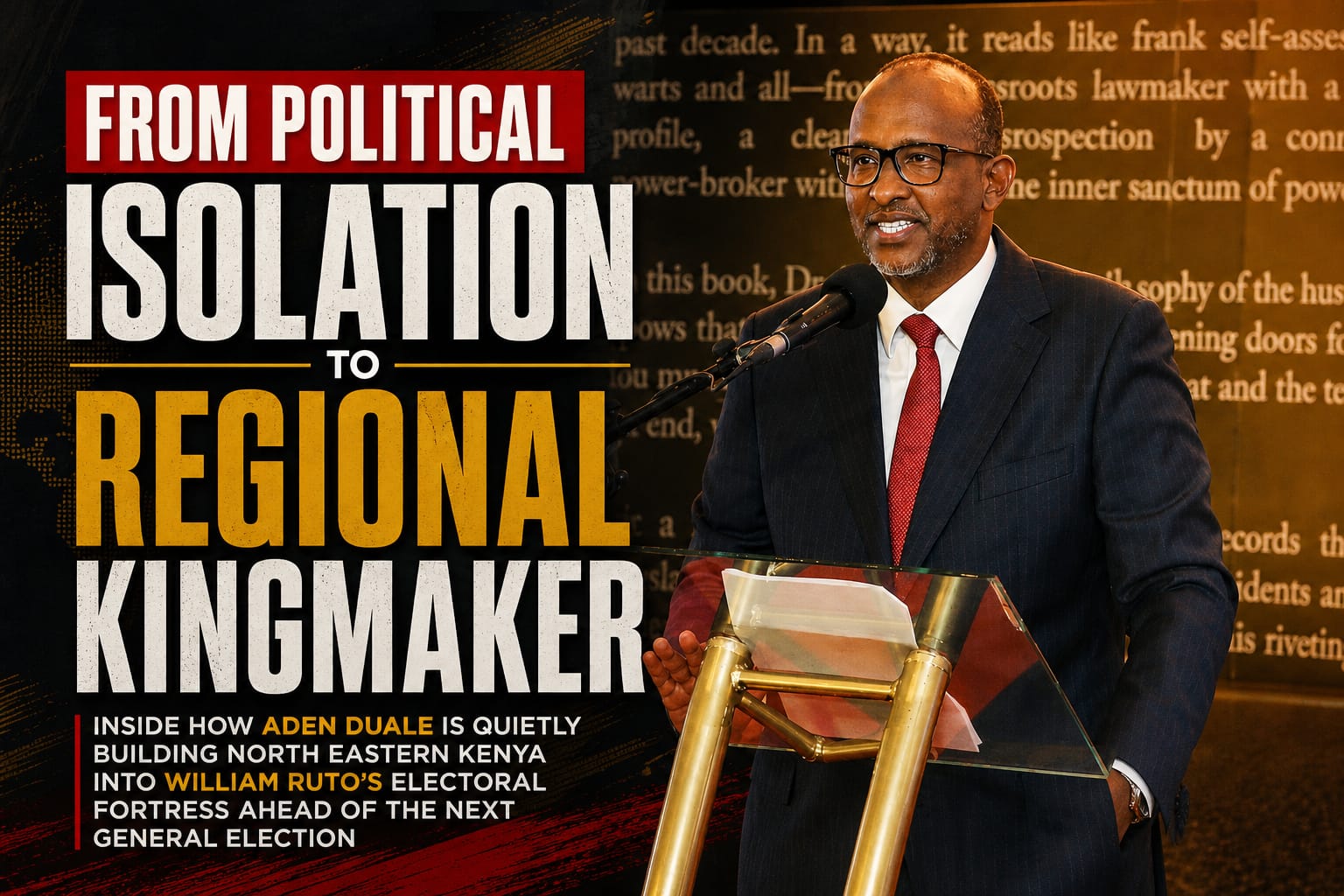
For years, politics in North Eastern Kenya revolved around isolation, mistrust, clan calculations, and a region that often felt politically detached from the center of government.
Leaders from Garissa, Wajir, and Mandera frequently complained of marginalization, underdevelopment, and being remembered only during election seasons or security crises. The region’s relationship with Nairobi was historically complicated sometimes cooperative, often suspicious.
Yet today, something remarkably different is taking shape.
At the center of that transformation stands Aden Duale a man who, just a few years ago, appeared politically isolated within much of North Eastern Kenya, but who has now emerged as one of the most influential architects of the region’s growing alignment with President William Ruto and the Kenya Kwanza administration.
From cabinet corridors in Nairobi to grassroots political gatherings across Garissa, Wajir, and Mandera, Duale’s influence has steadily expanded beyond his traditional political base. What was once seen as an individual political survival strategy has evolved into a broader regional political consolidation effort one aimed at anchoring North Eastern Kenya firmly within the government camp ahead of the next general election.
This political evolution did not happen overnight.
It has been built through a combination of strategic appointments, persistent political networking, religious and cultural engagement, state visibility, and perhaps most importantly, Duale’s ability to position himself as the bridge between State House and a region historically skeptical of central authority.
For President William Ruto, North Eastern Kenya represents more than just votes. It represents political stability in a region bordering Somalia, a Muslim voting bloc that can significantly influence national electoral arithmetic, and a symbolic demonstration that his administration has succeeded in broadening its national coalition beyond traditional strongholds.
And for Duale, the mission appears larger than personal political survival.
It increasingly resembles a long-term political architecture project.
Across the region, county leaders who once maintained distance from the government have gradually moved closer to the administration. MPs, senators, governors, religious figures, youth leaders, and local administrators have increasingly adopted a more cooperative tone with Nairobi. Government projects are being amplified politically. Cabinet visits have become more frequent. Public messaging has shifted from confrontation to partnership.
Many political observers now argue that no single individual has played a bigger role in engineering that shift than Duale.
His political journey itself reflects a broader transformation in North Eastern politics.
For years, Duale cultivated the image of a combative national figure outspoken, unapologetic, and deeply loyal to his political alliances. As Majority Leader during former President Uhuru Kenyatta’s administration, he became one of the most recognizable Somali-Kenyan politicians nationally. Yet that visibility also created friction within sections of North Eastern leadership, where some leaders viewed him as too confrontational or overly centralized in his political style.
At various points, he appeared politically cornered within his own backyard.
But the rise of William Ruto to the presidency dramatically altered that equation.
Duale became one of Ruto’s earliest and most vocal allies during periods when many established political elites distanced themselves from the then-Deputy President. That loyalty has since translated into enormous influence within government circles. Initially appointed to the Ministry of Defence before later moving to the health docket, Duale steadily expanded both his administrative footprint and political relevance.
Today, he is no longer viewed merely as a regional politician from Garissa.
He is increasingly perceived as the administration’s chief political mobilizer in North Eastern Kenya.
That role has become particularly important as Kenya’s political climate slowly begins shifting toward the next election cycle.
Within government circles, there is growing recognition that Ruto cannot afford to lose regions that currently support him. North Eastern Kenya, though not among the country’s most populous voting blocs, holds strategic electoral significance. The region’s voting patterns tend to move collectively once political elites align around a national candidate.
That is precisely the alignment Duale appears to be building.
His approach, however, has not relied solely on political rallies or partisan messaging. Instead, it has involved something more subtle embedding government presence into the daily political and social realities of the region.
Health sector reforms, national government projects, drought response initiatives, road infrastructure conversations, education funding discussions, and security cooperation have all increasingly become tied to a broader political narrative: that North Eastern Kenya benefits more when it works closely with the government rather than standing in opposition to it.
As Health Cabinet Secretary, Duale has also strategically used his ministry visibility to reinforce his political stature. Public health reforms, hospital visits, stakeholder meetings, and engagements with Muslim leaders have strengthened his national image while simultaneously boosting his regional influence.
Within many parts of North Eastern Kenya, there is a growing perception that the region currently enjoys unprecedented access to the presidency through Duale.
That perception matters enormously in Kenyan politics.
Historically, communities often align politically with leaders perceived to possess direct influence within the state machinery. Access to the presidency translates into expectations of development, appointments, projects, and government attention. In regions that have long complained of neglect, proximity to power becomes politically valuable.
Duale appears to understand this dynamic exceptionally well.
Rather than positioning himself as an outsider criticizing government failures from a distance, he has framed himself as an insider capable of delivering state access to the region.
That strategy has gradually pulled more regional leaders toward the government orbit.
Governors who once maintained cautious neutrality now appear more comfortable publicly engaging with the administration. MPs who previously criticized government policy have softened their rhetoric. Religious leaders increasingly participate in state functions. Youth empowerment meetings and business forums are often attended by senior government officials.
The political message being reinforced is clear: North Eastern Kenya is no longer politically isolated from the center of power.
And Duale is presenting himself as the man who made that reconnection possible.
The Quiet Consolidation of North Eastern’s Political Elite
Perhaps the most remarkable aspect of Duale’s growing influence is not his own rise, but his ability to bring together leaders who historically operated in fragmented political camps.
North Eastern politics has traditionally been deeply divided along clan, county, and personal rivalries. Mandera, Wajir, and Garissa leaders often pursued separate political strategies aligned with different national coalitions. Internal disputes frequently weakened the region’s collective bargaining power at the national level.
But recent political developments suggest a gradual shift toward coordination.
Senior regional leaders now increasingly appear together at government events. Delegations from the region frequently visit State House collectively. Cabinet secretaries and principal secretaries from the region are more visible in local political engagements. National government narratives are being echoed more consistently across county leadership structures.
Political observers argue that this consolidation is neither accidental nor spontaneous.
It is being carefully managed.
And Duale sits at the center of much of that coordination.
His influence is particularly visible in the administration’s outreach to Muslim communities. As one of the most prominent Muslim politicians in Kenya’s national leadership structure, Duale has become an important figure in the government’s efforts to strengthen relations with Muslim voters not just in North Eastern Kenya, but also in parts of Coast region and urban centers with significant Muslim populations.
This carries major electoral implications.
For decades, Muslim political sentiment in Kenya has often fluctuated depending on issues related to security policy, marginalization concerns, foreign policy debates, and state relations with religious institutions. Any administration seeking broad national legitimacy must navigate those dynamics carefully.
Within Ruto’s political coalition, Duale increasingly appears to function as both a regional mobilizer and a symbolic bridge to Muslim communities.
That role has only expanded amid ongoing geopolitical tensions affecting Muslim populations globally. Government engagement with religious leaders, madrasa stakeholders, humanitarian discussions, and Muslim civil society organizations has become more politically deliberate.
In many of those engagements, Duale remains highly visible.
At the same time, his political rise has not been free of criticism.
Critics argue that the growing alignment between regional leaders and the government risks weakening independent political oversight. Some opposition figures within North Eastern Kenya believe the region’s leadership has become overly centralized around state proximity rather than issue-based politics.
Others question whether the current political unity can survive underlying clan rivalries that have historically shaped regional elections.
There are also concerns among some activists that political loyalty to the administration should not replace accountability regarding underdevelopment, unemployment, healthcare challenges, insecurity, and recurring drought crises.
But even many critics acknowledge Duale’s effectiveness as a political organizer.
What distinguishes him from many regional politicians is his ability to operate simultaneously within local community structures and national power networks. He understands grassroots political language while also maintaining strong access to the presidency and state institutions.
That dual positioning gives him unusual political leverage.
His influence also reflects a broader transformation occurring within Kenyan politics itself.
Increasingly, regional political power is no longer determined solely by ethnic arithmetic or historical party loyalties. Access to state structures, cabinet visibility, national media presence, and administrative influence now play a much larger role in shaping political relevance.
Duale has adapted to that environment effectively.
He has evolved from a constituency-based politician into a regional political strategist with national significance.
For President Ruto, that transformation offers enormous political advantages.
Unlike previous administrations that sometimes struggled to maintain stable political relationships within North Eastern Kenya, the current government appears determined to institutionalize its support base in the region early rather than waiting until election periods.
Frequent high-level visits, appointments, development messaging, and strategic engagement with local elites all suggest a long-term political investment strategy.
And Duale appears to be one of its primary architects.
There is also a psychological dimension to the region’s current political alignment.
For many residents, seeing leaders from North Eastern occupying powerful national positions creates a sense of recognition and visibility that historically felt absent. Representation at the top levels of government carries symbolic weight in communities that have long perceived themselves as politically peripheral.
Duale’s prominence therefore extends beyond ordinary political calculations.
To supporters, he represents proof that North Eastern Kenya can produce nationally influential leaders capable of shaping state policy rather than merely reacting to it.
That symbolism strengthens his political appeal.
Still, the durability of this emerging political architecture will ultimately depend on delivery.
Political unity sustained only through elite coordination without visible improvements in infrastructure, healthcare, education, employment, and security could eventually face public frustration. Voters across Kenya increasingly demand tangible outcomes alongside political loyalty.
The government’s challenge will therefore be converting political goodwill into measurable development progress.
For now, however, the momentum clearly favors the administration in North Eastern Kenya.
The opposition remains fragmented in the region, while government-aligned leaders appear increasingly coordinated. Public messaging from influential regional figures largely emphasizes partnership with Nairobi rather than confrontation. State visibility has expanded. Political access has improved.
At the center of much of that transformation stands Aden Duale.
Once politically isolated in parts of his own region, he has gradually rebuilt himself into perhaps the single most influential political figure connecting North Eastern Kenya to the current administration.
Whether one admires or criticizes him, his impact on the region’s political direction is becoming difficult to ignore.
As Kenya slowly inches toward another high-stakes electoral cycle, the battle for regional alliances, voting blocs, and political loyalty is already quietly unfolding behind the scenes. In North Eastern Kenya, that contest appears increasingly shaped not through loud populist campaigns or dramatic confrontations, but through careful relationship-building, elite coordination, institutional influence, and sustained state proximity.
Duale’s growing influence reflects precisely that kind of politics disciplined, strategic, and deeply embedded within the machinery of power.
And if current trends continue, historians of Kenyan politics may eventually look back at this period as the moment when North Eastern Kenya ceased being merely a peripheral electoral region and instead became a carefully organized political pillar within the national governing coalition.
At the heart of that transformation will likely stand one man whose political journey mirrors the region’s own evolving relationship with power, Aden Duale once politically alone, now the quiet architect behind a region steadily consolidating itself around the government and President William Ruto’s re-election ambitions.