

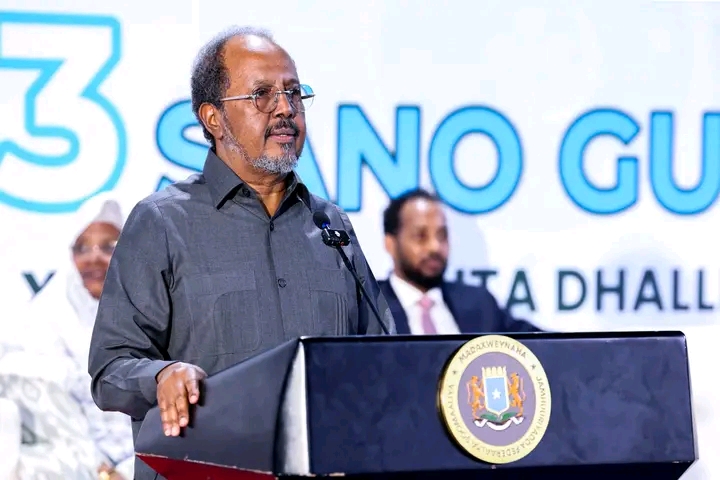
The political battle over Somalia’s future entered a new and defining phase after Hassan Sheikh Mohamud delivered one of his strongest and most direct speeches yet, firmly declaring that both his mandate and that of the Federal Parliament remain valid until May 15, 2027, while insisting that Somalia’s new constitutional direction and one-person-one-vote elections are irreversible.
Speaking during celebrations marking Somali Youth Day, the Somali president appeared determined, confrontational, and politically confident as he addressed the escalating standoff between the federal government and opposition politicians over the country’s electoral future. His speech came only hours after internationally mediated political talks in Mogadishu between the government and opposition groups collapsed without agreement, exposing deep divisions over how Somalia should conduct its next national elections.
“The mandate of the current Parliament and that of the President of Somalia will expire on 15 May 2027,” Hassan Sheikh said. “My term and that of Parliament are five years. Let us wait until May 15, 2027. The constitution is in force and the election will be one person, one vote.”
Those words now stand as perhaps the clearest political response yet to opposition figures who have repeatedly argued that the president’s legitimacy and mandate are under question following the constitutional amendments approved by the Somali parliament. Instead of softening his tone or leaving room for compromise, Hassan Sheikh used the national platform to send a blunt message that his administration considers the constitutional process completed and binding.
The president’s remarks are likely to reshape the political debate in Somalia in the coming months because they indicate that Villa Somalia is no longer speaking about one-person-one-vote elections as a proposal or political ambition. The government is now presenting it as a constitutional obligation that must happen regardless of resistance from opposition groups.
Throughout the speech, Hassan Sheikh repeatedly framed the opposition as politicians trapped in an outdated clan-based political order. He accused some political actors of intentionally creating dysfunction and instability in order to preserve the indirect electoral system that has dominated Somalia for decades. According to the president, the country has now reached a moment where Somalia must either transition into direct democratic elections or remain stuck in endless political uncertainty driven by clan calculations and elite negotiations.
“The opposition has no agenda other than clan-based elections,” the president suggested during his remarks, arguing that Somalia cannot continue recycling the same political model while expecting different national outcomes.
The speech carried strong emotional and political undertones. Observers noted that Hassan Sheikh appeared visibly angry as he defended his administration’s record and attacked critics of the electoral reforms. At one point, he compared the recent local elections held under the new framework to the controversial 2018 election in Baidoa, a vote that became one of the darkest political episodes in recent Somali history after violence, political confrontation, and deaths followed disputes over the electoral process.
The president argued that unlike the events surrounding the Baidoa election, the more recent election conducted under the current administration did not result in fatalities, which he presented as evidence that Somalia is capable of moving toward broader democratic participation without descending into chaos.
“Baidoa’s 2018 election brought deaths and instability,” the president said while defending the current process. “Yesterday’s election did not lead to any fatalities.”
That comparison was politically significant. Hassan Sheikh was not only defending the current elections taking place under the new constitutional framework, but also attempting to redefine the national conversation around legitimacy and stability. By contrasting past violence with current elections, he aimed to portray the federal government as a force for democratic transition rather than political conflict.
The president also repeatedly highlighted recent elections in Mogadishu and the just-concluded process in South West State as examples of what he believes should become the national standard across the rest of the country. According to Hassan Sheikh, Somalia cannot selectively apply democratic reforms in certain regions while resisting them elsewhere.
He insisted that every federal member state must eventually transition into the same model and suggested that the momentum behind one-person-one-vote elections is now too strong to reverse. This position will likely intensify tensions with opposition leaders and some regional political actors who fear that Somalia lacks the security, political trust, and institutional readiness necessary for nationwide direct elections.
Yet Hassan Sheikh’s speech showed little indication that the government intends to retreat.
Instead, the president framed the issue as a historic generational responsibility, particularly for Somali youth. Speaking during Somali Youth Day celebrations added symbolic weight to his message. He repeatedly urged young Somalis to engage in political discussions, defend constitutional governance, and become active participants in shaping Somalia’s democratic future.
For Hassan Sheikh, the youth appear central to the political legitimacy of the one-person-one-vote agenda. His administration increasingly presents the electoral transition not simply as a technical constitutional reform but as a national movement meant to empower ordinary citizens beyond clan structures and elite political deals.
That message may resonate strongly with sections of urban youth, especially younger Somalis frustrated by decades of indirect elections negotiated by political elites behind closed doors. Many young Somalis have grown up without ever directly voting for a national leader, making the promise of universal suffrage emotionally powerful and politically transformative.
But the opposition remains deeply skeptical.
Opposition politicians argue that the federal government is attempting to impose major constitutional and electoral changes without sufficient national consensus. They insist that Somalia’s fragile political environment requires broad agreement among stakeholders before implementing such a major transformation. Some critics also fear that the current administration could use state institutions and security structures to dominate the electoral process under the banner of democratization.
This disagreement explains why the internationally mediated talks in Mogadishu failed to produce a breakthrough. The talks were meant to reduce political tensions and create consensus on the election model ahead of the next national vote. Instead, both sides emerged holding firmly to opposing positions.
The government wants direct elections anchored in the amended constitution. The opposition continues demanding an indirect electoral model built around clan representation and negotiated power-sharing arrangements.
Hassan Sheikh’s latest speech now suggests the federal government views that debate as effectively settled.
Politically, this is a risky but calculated strategy.
By speaking with such certainty and constitutional confidence, the president appears to believe that projecting strength is more beneficial than appearing uncertain or defensive. His supporters are likely to interpret the speech as leadership and clarity at a time when Somalia faces political confusion and intense internal disagreements.
Critics, however, may see the same speech as evidence of growing political rigidity and unwillingness to compromise.
The timing of the remarks also matters enormously. Somalia is entering a sensitive political period where questions about legitimacy, constitutional authority, federalism, and electoral credibility could shape the country’s stability for years. International partners are watching closely because Somalia’s security gains and state-building efforts remain closely tied to political consensus among Somali leaders.
What became clear from Hassan Sheikh’s address is that Villa Somalia believes the political tide has shifted decisively toward constitutional implementation and direct elections. The president no longer sounds like a leader testing an idea. He sounds like a leader preparing the country for confrontation over its political future if necessary.
That is why his remarks during Somali Youth Day may ultimately become one of the most consequential political speeches of his presidency.
The message was unmistakable: the constitution is active, the mandate remains intact until May 2027, and one-person-one-vote elections are no longer negotiable in the eyes of the federal government.
Whether that position leads Somalia toward democratic transformation or deeper political polarization will now depend on what happens in the difficult months ahead.