

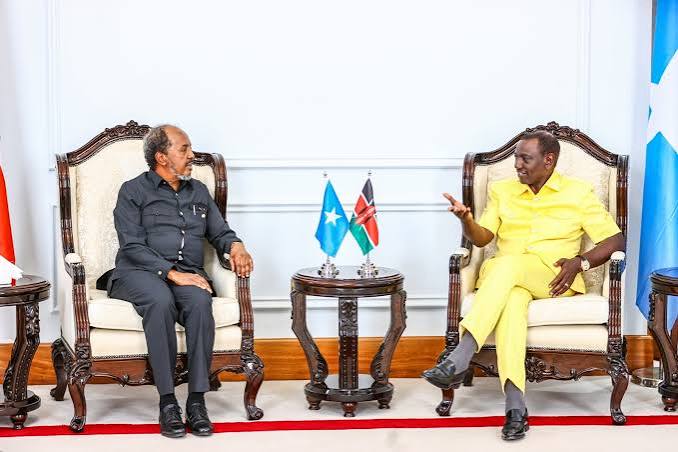
A discreet diplomatic encounter between Somalia’s President Hassan Sheikh Mohamud and Kenya’s President William Ruto in Kenya has drawn regional attention, coming at a time of heightened political uncertainty in Mogadishu and renewed international concern over stability in the Horn of Africa.
While the meeting has not been officially detailed in full, multiple informed sources indicate that the Somali leader travelled to Kenya on a working visit and held high-level talks with President William Ruto in what is being described as a largely private and carefully managed engagement.
The discussions are understood to have taken place away from public scrutiny, with locations cited along Narok, adding to the sense of confidentiality surrounding the visit.According to diplomatic and media sources tracking the visit, President Hassan Sheikh Mohamud’s trip was not accompanied by the usual level of public state communication, a factor that has fueled speculation about the sensitivity of the agenda.
Some reports suggest the Somali president arrived in Kenya for a working visit at the invitation of President Ruto, while others describe the trip as unannounced, reflecting the fluid nature of high-level diplomacy between the two neighboring states.
What remains consistent across accounts is that the meeting was substantive, focusing on bilateral relations, regional stability, and the increasingly complex political situation in Somalia.At the center of the discussions is the evolving relationship between Kenya and Somalia, two countries whose cooperation has improved significantly in recent years after periods of diplomatic strain.
Security coordination, trade relations, and border management remain key pillars of engagement, especially given the shared threat of Al-Shabaab and the strategic importance of cross-border stability.
The meeting is understood to have reaffirmed commitments to continued cooperation in security operations, intelligence sharing, and regional development initiatives, even as broader political tensions continue to shape Somalia’s internal landscape.
However, the timing of the visit has also placed it firmly within the context of Somalia’s ongoing political and electoral challenges. Somalia continues to grapple with disagreements over its electoral model, constitutional interpretation, and power-sharing arrangements between the federal government and member states.
These disputes have slowed political reforms and created uncertainty around the country’s democratic transition. Against this backdrop, regional partners, including Kenya, have increasingly expressed concern about the implications of prolonged political fragmentation in Somalia.
President Ruto has in recent months adopted a carefully diplomatic but firm tone when addressing Somalia’s internal situation. While avoiding direct interference, he has repeatedly emphasized that Somalia’s stability is closely tied to national unity and cooperation between the federal government in Mogadishu and regional administrations.
In his public and diplomatic messaging, Ruto has warned that unresolved disputes over elections and governance structures risk undermining progress in state-building and weakening coordinated efforts to combat extremism in the region.
These remarks have been interpreted in diplomatic circles as reflecting not only Kenya’s national security interests but also broader international expectations.
The Horn of Africa remains a strategic priority for global partners who view Somalia’s stability as essential to regional peace, maritime security, and counterterrorism efforts.
In this context, Ruto’s position is seen as aligning with a wider consensus that Somalia must accelerate inclusive political dialogue and establish a predictable electoral framework to avoid recurring crises.
The reported meeting between the two leaders therefore appears to have carried both bilateral and regional significance. On one level, it reinforced Kenya and Somalia’s shared commitment to cooperation in security and economic development.
On another, it provided an informal channel through which concerns about Somalia’s internal political trajectory could be communicated at the highest level.
Sources suggest that discussions touched on the importance of maintaining dialogue between Somalia’s federal government and its member states, as well as the need to avoid further escalation of political tensions that could destabilize governance structures.
The setting of the meeting has also attracted attention. Reports indicating that the talks have taken place in Narok, near President Ruto’s private engagements, have added a layer of informality to what is typically a highly structured diplomatic process.
Such locations, away from official government buildings in Nairobi, often allow for more candid exchanges between leaders, especially when addressing sensitive regional issues.
While neither government has fully detailed the itinerary, the nature of the venues has reinforced the perception that the meeting was deliberately kept low-profile.
Another key dimension of the talks is the broader Kenya–Somalia border issue, particularly the gradual reopening of cross-border movement and trade. In recent years, the two countries have made progress toward normalizing relations after periods of tension that saw border restrictions and diplomatic disagreements.
However, full reopening and normalization remain incomplete, with security concerns and political uncertainty in Somalia continuing to influence the pace of implementation.
Analysts believe that Kenya’s position on border reopening is closely tied to Somalia’s internal stability, with Nairobi seeking assurances that governance structures in Somalia are sufficiently stable to manage cross-border risks.
From an international perspective, the meeting also reflects the continued engagement of external partners in Somalia’s political process.
Donor governments and regional organizations have consistently encouraged Somali leaders to reach consensus on electoral frameworks and constitutional reforms.
The underlying concern is that political deadlock in Somalia not only delays domestic governance reforms but also creates openings for extremist groups to exploit instability.
In this sense, diplomatic engagements such as the one between Ruto and Hassan Sheikh are seen as part of a broader effort to maintain momentum toward stability.
The Somali presidency has described the engagement in general terms, emphasizing the strengthening of bilateral relations and reaffirming cooperation between the two countries in promoting peace, stability, and development in the region.
While this official framing avoids reference to any political tension or sensitive agenda items, it aligns with Somalia’s broader diplomatic strategy of maintaining constructive relations with neighboring states while managing internal political debates at home.
Still, the contrast between public statements and behind-the-scenes reports highlights the complexity of regional diplomacy.
On the surface, the visit is presented as a routine working engagement between two neighboring heads of state.
Beneath that surface, however, lies a more intricate set of discussions shaped by Somalia’s political uncertainties, Kenya’s security priorities, and the expectations of international stakeholders.
The timing of the meeting is particularly significant given recent developments in the Horn of Africa. Somalia’s political climate remains fluid, with debates over electoral models continuing to dominate national discourse.
At the same time, security challenges linked to extremist activity persist, requiring sustained regional coordination. Kenya, as both a neighboring state and a key regional actor, has a direct interest in ensuring that Somalia’s internal stability is preserved, both for security reasons and for the continuation of economic integration efforts.
In this context, President Ruto’s engagement with President Hassan Sheikh can be seen as part of a broader diplomatic balancing act. Kenya seeks to support Somalia’s state-building process while also safeguarding its own national interests, particularly in border security, trade, and regional stability.
This dual approach requires maintaining open channels of communication with Somali leadership, even when internal Somali politics are contentious or unresolved.
Ultimately, the reported meeting underscores the delicate interplay between domestic politics and regional diplomacy in the Horn of Africa.
It reflects how leadership interactions between Nairobi and Mogadishu are increasingly shaped not only by bilateral considerations but also by broader geopolitical pressures.
Whether viewed as a routine diplomatic engagement or a more strategic confidential consultation, the meeting highlights the continuing importance of Kenya–Somalia relations at a time when the region faces both opportunities and significant challenges.
As details continue to emerge, the encounter between William Ruto and Hassan Sheikh Mohamud will likely be interpreted through multiple lenses diplomatic, political, and strategic.
What remains clear is that both leaders are operating within a complex regional environment where stability, cooperation, and political consensus are deeply interconnected, and where even private meetings carry implications far beyond the room in which they are held.