

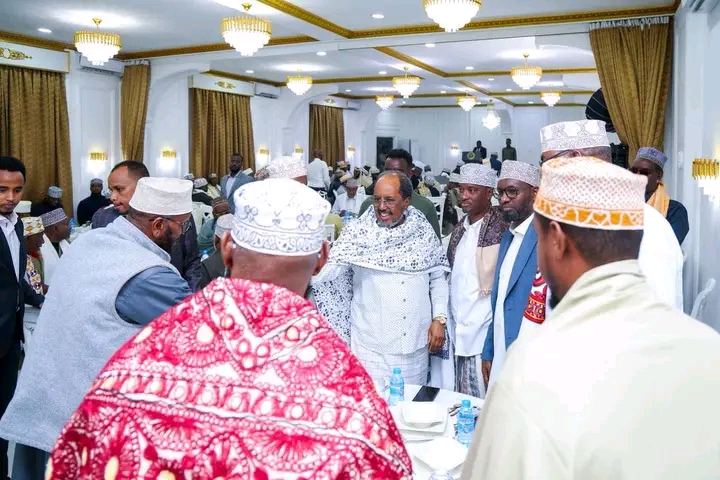
In Somalia’s already complex political landscape, where governance is shaped by a delicate balance between formal state institutions, clan dynamics, and fragile federal arrangements, President Hassan Sheikh Mohamud’s recent remarks to traditional elders in Mogadishu have introduced a sharper tone than usual.
His repeated insistence that the country’s transition to a one-person, one-vote electoral system is “non-negotiable” is not just a policy position it is a political declaration with deep implications for Somalia’s immediate stability, its constitutional trajectory, and the future of its political settlement.
The dinner meeting at Villa Somalia, attended by traditional elders from across Somali regions, was initially framed as a consultative engagement. Yet beneath the formal setting and cultural symbolism of elders as custodians of peace, the exchange revealed a widening gap between presidential resolve and elite consensus. The President’s message was consistent and forceful, Somalia must move away from indirect clan-based electoral systems and fully embrace direct elections.
He stated, in words that now define the political moment, that it is “non-negotiable that the Somali people must obtain their constitutional right to elect the leaders they want after 57 years.” He further argued that “incomplete elections, have left us with many problems, foremost among them insecurity.”
These statements are not merely rhetorical. They are a framing device that links Somalia’s insecurity problem directly to its electoral system. In doing so, the President is not only advocating for reform but assigning political blame to the current structure of indirect elections, effectively delegitimizing the existing power-sharing model that has defined Somali politics for decades.
At the core of this argument is a powerful democratic appeal: that legitimacy flows only from direct popular participation. In principle, this is consistent with global democratic norms. However, Somalia is not operating in a typical political environment.
The country’s electoral model has historically been a hybrid system built on clan representation, negotiated power-sharing, and indirect selection of parliamentarians who then choose the president. This system, while widely criticized for entrenching elite bargaining and corruption risks, has also been a stabilizing mechanism in a fragmented society.
By declaring a full shift to one-person one-vote as non-negotiable, President Hassan Sheikh Mohamud is effectively attempting to accelerate a transformation that has repeatedly stalled due to structural constraints.
The question, therefore, is not whether universal suffrage is desirable it is whether it is feasible within Somalia’s current political and security architecture, and what risks emerge when political ambition outpaces institutional readiness.
The President’s framing of the issue as a constitutional right also deserves attention. By invoking constitutional language, he elevates the debate from political disagreement to legal and moral obligation. Yet Somalia’s provisional constitution itself remains contested, with unresolved chapters and disputed interpretations regarding federal authority, electoral design, and state competencies.
This creates an immediate contradiction, a “non-negotiable” electoral model is being asserted within a constitutional framework that is itself incomplete and politically disputed.
During his engagement with elders, the President also emphasized the role of traditional leaders, stating that “traditional elders have always been the backbone of peace, unity, and reconciliation in our society” and urging them to support the transition toward direct elections. This appeal is politically strategic.
In Somalia, elders are not symbolic figures they are active political intermediaries who historically determine parliamentary selection and maintain influence over local legitimacy structures.
However, the elders’ reported response in the meeting was notably cautious and, according to accounts, deeply concerned. They urged the President to engage opposition actors in “genuine dialogue” on three urgent issues: constitutional clarity, the electoral model, and the institutional capacity required to conduct credible elections within a limited timeframe.
Importantly, they framed consensus not as optional but as essential, given Somalia’s fragility and reliance on international support.
This divergence reveals a fundamental tension: the President’s emphasis on decisiveness versus the elders’ emphasis on consensus. In Somalia’s political culture, consensus is not merely procedural it is foundational. Decisions imposed without broad agreement risk fragmentation, resistance, and institutional paralysis.
Yet the President’s response, as reported, did not engage deeply with these concerns. Instead, he returned to three core positions, rejection of indirect elections, confidence in the inevitability of universal suffrage, and an open but conditional door to dialogue. The conditionality is crucial. Dialogue, in this framing, appears to be acceptable only if it does not alter the core trajectory already set by the presidency.
This is where the political friction becomes more pronounced. Opposition actors and some federal member states have long expressed concern that the push for one-person, one-vote is being advanced without sufficient institutional groundwork. Voter registration systems remain incomplete, electoral boundaries are contested, and security threats particularly from Al-Shabaab in several regions continue to restrict administrative reach.
In this context, the insistence on immediacy raises questions about sequencing: whether Somalia is prioritizing political outcomes before technical readiness.
The President’s linking of indirect elections to insecurity also introduces a controversial causal argument. While it is true that Somalia’s indirect system has been associated with corruption, elite capture, and political instability, insecurity in Somalia is also driven by insurgency, weak state presence, and regional fragmentation. To attribute insecurity primarily to the electoral model simplifies a multidimensional problem and risks politicizing security discourse.
At another level, the President’s rhetoric signals a deliberate attempt to delegitimize the existing political order. By describing past elections as “incomplete” and associating them with national problems, he is reframing Somalia’s political history as a series of flawed compromises that must now be corrected through structural overhaul. This narrative is powerful because it positions the current administration as the agent of historical correction rather than just political continuity.
However, such framing also creates political winners and losers. Those who benefited from the indirect system regional leaders, clan elders with parliamentary influence, and established political networks may perceive this shift as a direct threat to their power. The opposition’s interpretation, as reflected in political commentary, is that the President is effectively changing the rules of political competition in a way that reduces the leverage of traditional power brokers and forces a transition to mass-based electoral politics.
In practical terms, this would reshape Somalia’s political economy. Campaigning would shift from elite negotiation to voter mobilization. Political financing would become more decentralized but also more expensive. Accountability mechanisms would become more direct but potentially more volatile. These shifts are not inherently negative, but they require institutional maturity that Somalia is still in the process of building.
The President’s insistence that this transition is “non-negotiable” therefore introduces a rigidity into a system that has historically depended on flexibility. In transitional political environments, rigidity can be both a strength and a risk. It provides direction and clarity, but it can also reduce space for compromise, which is often essential for avoiding political deadlock.
The timing of these statements also matters significantly. With the expiration of parliamentary mandates and the approaching end of the presidential term cycle in 2026, Somalia is entering a politically sensitive period. Traditional elders, civil society actors, and international partners have increasingly called for consensus-based arrangements to avoid constitutional crisis.
Against this backdrop, the President’s firm stance may be interpreted as an attempt to lock in an electoral trajectory before political negotiations fully unfold.
Another dimension of the President’s messaging is his critique of former leaders. He has publicly accused past presidents and prime ministers of obstructing electoral reform, even recounting how he sent “business class tickets” for meetings that were declined. While this may be intended to highlight resistance from the political establishment, it also deepens generational and institutional divides within Somalia’s elite class.
It frames the current debate not just as policy disagreement, but as a struggle between reformist leadership and entrenched political actors.
This personalization of political resistance is significant. It shifts the discourse from structural critique to individual accountability, potentially making consensus more difficult. In systems where trust between elites is already fragile, public accusations can harden positions rather than open dialogue.
From a broader analytical perspective, what is unfolding is a classic transitional governance dilemma, the tension between democratic idealism and institutional realism.
On one side is the aspiration for universal suffrage, direct legitimacy, and citizen-driven governance. On the other is the reality of fragmented authority, security constraints, and incomplete state infrastructure.
President Hassan Sheikh Mohamud’s position clearly aligns with the transformative side of this equation. He is attempting to push Somalia toward a modern electoral democracy based on direct participation. But the resistance he faces whether from opposition actors, federal states, or traditional leaders is rooted not necessarily in opposition to democracy, but in concern over sequencing, stability, and feasibility.
The critical question is whether Somalia can manage this transition without triggering institutional breakdown or political polarization. The President’s confidence that universal suffrage is “inevitable” reflects political determination, but inevitability in political systems is rarely linear. It depends on negotiation, compromise, and gradual institutional development.
If the current trajectory continues without broader consensus, Somalia risks entering a period where competing visions of legitimacy coexist without resolution: one rooted in direct electoral mandate, and another in negotiated clan-based representation. Such dual legitimacy structures are historically unstable and often lead to governance paralysis.
Yet dismissing the President’s position as unrealistic would also be incomplete. There is genuine public demand, particularly among younger Somalis, for more direct participation in governance. The indirect system has long been criticized for enabling corruption and weakening accountability. In this sense, the push for reform is not only top-down but also responsive to societal aspirations.
The challenge lies in bridging these two realities: reform momentum and structural constraint. Without bridging mechanisms, even well-intentioned reforms can produce unintended consequences.
President Hassan Sheikh Mohamud’s “non-negotiable” stance on one-person, one-vote elections represents one of the most assertive democratic reform positions in Somalia’s recent political history. It signals a decisive break from purely consensus-based electoral engineering toward a more direct legitimacy model.
However, it also exposes deep fault lines in Somalia’s political architecture between ambition and capacity, between reform and stability, and between centralized political vision and decentralized traditional authority.
Whether this moment becomes a turning point toward democratic consolidation or a source of renewed political tension will depend not only on presidential determination, but on whether Somalia’s political actors can transform confrontation into structured consensus.
In the absence of that consensus, even the most strongly stated political commitments risk becoming not instruments of transformation, but triggers of renewed political uncertainty.