

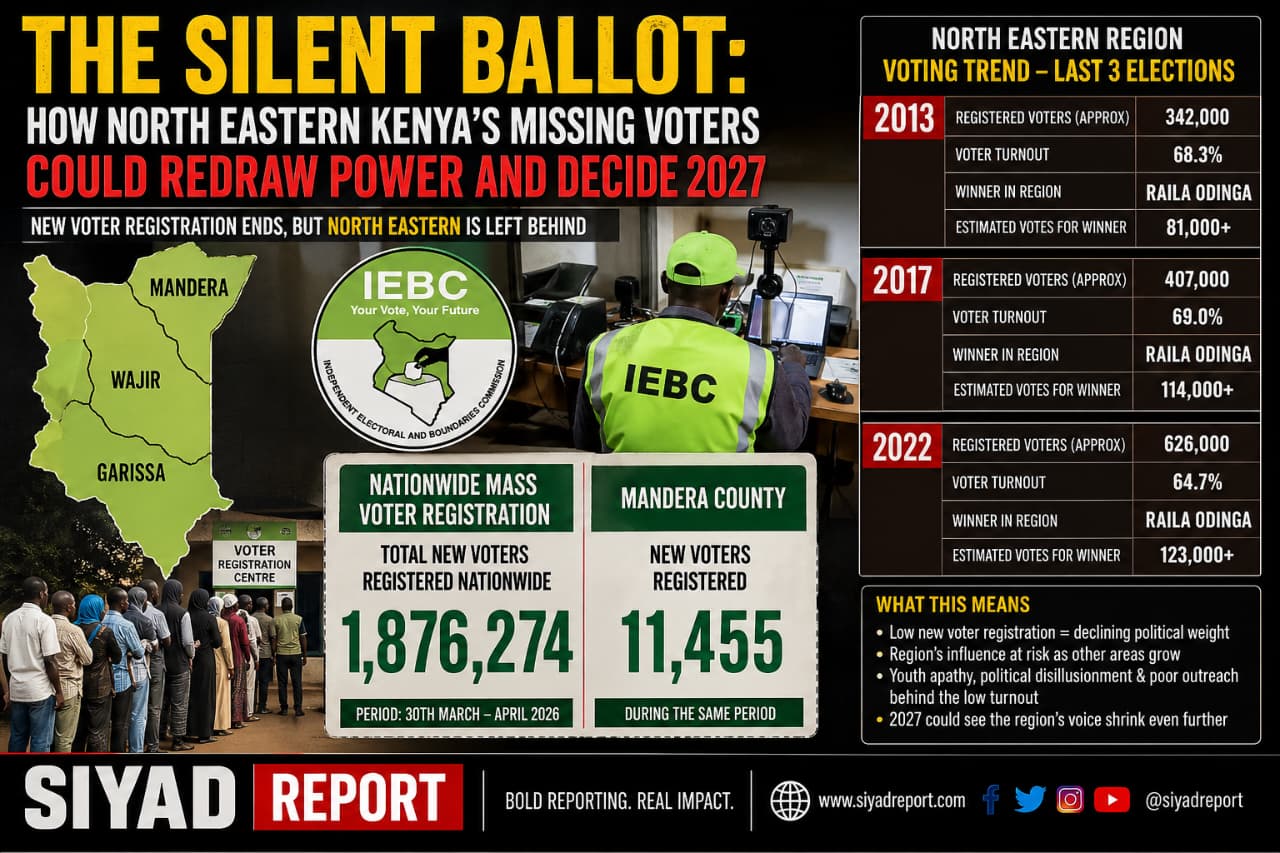
When the Independent Electoral and Boundaries Commission (IEBC) quietly closed its latest voter registration window after just under a month of intensified activity across the country, the national headline was simple and celebratory: 1,876,274 new voters added to the register.
It was framed as momentum, a sign of democratic expansion, a pulse check that suggested Kenya’s electoral engine was still capable of drawing in first-time voters, particularly the youth.
But beneath that national figure lies a more uncomfortable story one that does not scream in numbers but whispers through absence. Nowhere is that silence louder than in North Eastern Kenya.
In a region comprising Garissa County, Wajir County, and Mandera County, the outcome of the same exercise tells a very different story. While the rest of the country surged forward, the North Eastern region barely moved the needle.
The only clearly published figure Mandera’s 11,455 new voters offers a glimpse into what appears to be a broader regional trend of low uptake, limited enthusiasm, and a deepening democratic gap.
This is not just about numbers. It is about political weight, bargaining power, and the future direction of national leadership.
Across Kenya, the 1.87 million new registrations represent a significant expansion of the electorate. Yet when placed against the national ambition often cited at 2.5 million new voters it already signals a shortfall. Now narrow that lens further to North Eastern, and the gap becomes not just statistical, but structural.
If Mandera, the largest of the three counties by voter population, could only register just over eleven thousand voters during a nationwide push, then the implied figures for Garissa and Wajir though not officially published suggest similarly modest increases. Even under generous estimation, the region’s contribution to the national total likely falls far below 2 percent of the total new voters added nationwide.
This is a region that has historically struggled to assert its electoral influence not because of population size, but because of participation patterns. The latest figures only reinforce that long-standing pattern: North Eastern is present in Kenya’s electoral map, but not fully active within it.
The implications of this are far-reaching.
At a purely numerical level, elections in Kenya are decided by margins that increasingly rely on mobilized blocs of voters. Regions that demonstrate growth in voter registration automatically increase their leverage not just during elections, but in the negotiations, alliances, and policy considerations that precede them. In contrast, regions that lag behind risk becoming politically peripheral, their concerns acknowledged rhetorically but not prioritized strategically.
North Eastern Kenya now finds itself at that crossroads again.
The low turnout in registration is not occurring in isolation. It mirrors past electoral cycles where voter turnout, while occasionally high on election day, has not been matched by aggressive expansion of the voter base itself. In simple terms, those who are registered often vote but the number of registered voters does not grow fast enough to keep up with population realities.
And this is where the deeper political story begins to unfold.
In the 2013 general election, the region largely aligned with the then opposition under Raila Odinga, contributing to a broader coalition that drew support from historically marginalized areas. By 2017, the dynamics remained relatively consistent, with North Eastern maintaining its orientation toward opposition politics, even as national narratives shifted.
However, the 2022 general election marked a subtle but important shift.
William Ruto, running on a populist “hustler” narrative, made inroads into regions that had not traditionally aligned with him. While North Eastern did not become a stronghold for Ruto, it also did not deliver the kind of overwhelming opposition vote margins seen in previous cycles. Instead, the vote was more fragmented, reflecting a region in political transition rather than fixed alignment.
That transition now meets a new variable: a stagnant voter registration base.
The question is no longer just who the region supports, but how many voters the region can actually bring to the table.
Because in modern Kenyan politics, numbers are currency.
The Quiet Crisis Beneath the Numbers
The low turnout in North Eastern’s voter registration is not best explained by administrative barriers or documentation issues. Those explanations, while often cited, do not fully capture the reality on the ground today. The deeper drivers are more political, more psychological, and more structural.
One of the most significant factors is political disengagement born out of perceived irrelevance.
Over time, a narrative has taken root among segments of the population that electoral participation does not meaningfully alter their lived realities. Infrastructure gaps, economic marginalization, and security concerns persist across electoral cycles, regardless of which coalition is in power. This creates a feedback loop, if elections do not deliver tangible change, then the incentive to register as a voter diminishes.
Closely tied to this is the issue of elite-driven politics.
In many parts of North Eastern, political mobilization is heavily influenced by local elites politicians, clan leaders, and influential networks. When these actors are fully engaged, voter turnout can surge dramatically. But when the political environment is fragmented, or when elite consensus is absent, the energy required to drive mass registration simply does not materialize.
The latest registration exercise appears to have suffered from precisely this dynamic. Despite public calls from leaders urging youth and first-time voters to register, there was no unified, sustained mobilization effort capable of translating those calls into numbers.
Another critical factor is migration and transience.
North Eastern has a significant population that moves frequently between rural and urban centers, across county lines, and in some cases across international borders. This mobility complicates the process of building a stable and expanding voter register. Individuals may delay registration, unsure of where they will ultimately vote, or disconnected from the localized campaigns that typically drive registration drives.
There is also a growing element of youth apathy shaped by national political fatigue.
Kenya’s political landscape has become increasingly polarized, with recurring narratives, familiar personalities, and cyclical alliances. For many young people, particularly in regions that feel excluded from the core of national decision-making, the political process appears repetitive rather than transformative. Registration, in this context, becomes less of a civic duty and more of an optional exercise with uncertain payoff.
All these factors converge to produce the numbers now visible in the IEBC data.
And those numbers, though quiet, carry loud consequences.
Looking ahead to the next general election, the implications are both immediate and long-term.
If current trends hold, North Eastern will enter the election with minimal growth in its voter base, effectively maintaining its existing electoral weight while other regions expand theirs. This creates an imbalance where the region’s relative influence declines, even if its absolute number of voters remains stable.
For William Ruto, this presents a complex equation.
On one hand, North Eastern has not been his strongest base historically. On the other hand, the region’s fluid political alignment means it remains a potential swing bloc, particularly in a tightly contested election. However, the low registration numbers limit the extent to which that potential can be realized.
In practical terms, even if Ruto were to significantly improve his performance in North Eastern compared to 2022, the overall impact on his national vote tally would be constrained by the size of the electorate itself.
This is the paradox now facing both the president and his rivals: North Eastern matters politically, but its ability to shift outcomes is capped by its own participation levels.
Yet that does not mean the region will be ignored.
In fact, low registration can sometimes increase the strategic value of a region. With fewer voters to mobilize, targeted campaigns, localized alliances, and focused resource deployment can yield higher returns per voter. This could lead to more intense, micro-level political engagement as parties seek to maximize influence within a limited voter pool.
At the same time, opposition figures will likely continue to view North Eastern as a region where historical support can be consolidated and protected, even if it cannot be dramatically expanded in the short term.
What emerges, then, is a region that remains politically relevant, but in a different way: not as a growing powerhouse, but as a stable yet limited battleground.
The deeper question, however, goes beyond electoral strategy.
It is about what it means for a democratic system when entire regions consistently underperform in voter registration. Representation, after all, is not just about who wins elections it is about who shows up to define them.
In North Eastern Kenya, the gap between population and participation continues to widen.
And unless that gap is addressed not just through administrative fixes, but through restoring faith in the political process itself the region risks becoming a permanent undercurrent in Kenya’s democracy: present, counted, but not fully heard.
The 1.87 million new voters added nationwide tell a story of growth.
But in the silence of North Eastern’s numbers, another story is unfolding.
One that could shape not just the next election but the very balance of power in the country.